
Look at the relationships, not the parts.
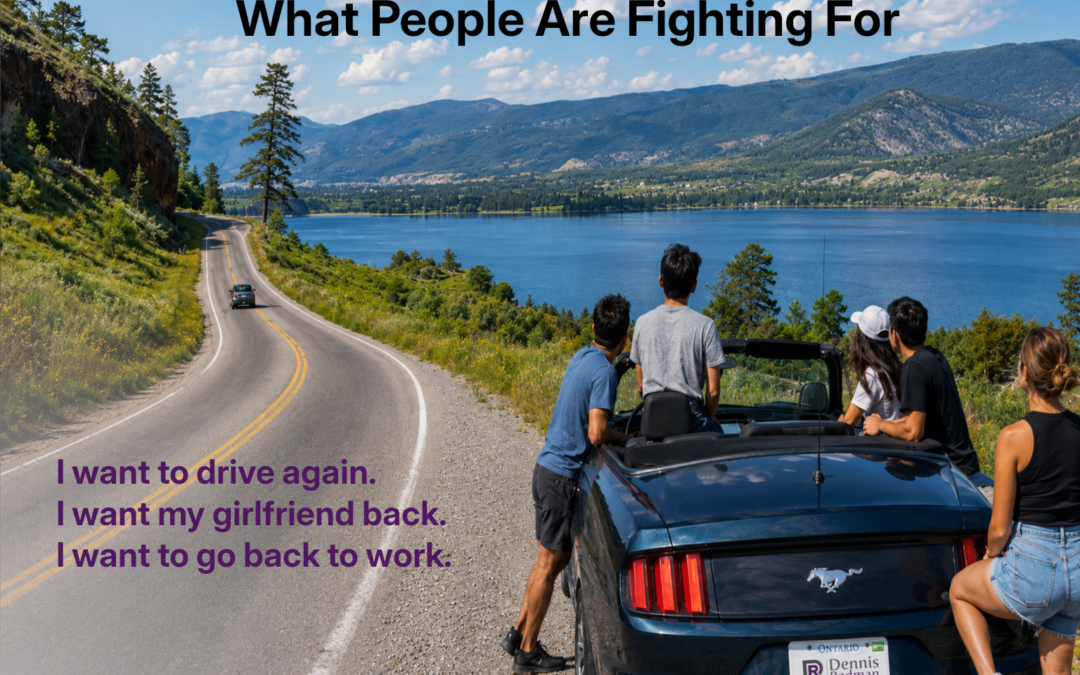
In rehabilitation, people often tell us what matters in the plainest possible language. Someone says, “I want my girlfriend back.” Someone else says, “I want to drive again.” Another person says, “I want to go back to work.” They are not speaking in the language of treatment plans, outcome measures, or clinical domains. They are speaking from the centre of a life that has been interrupted. They are trying to return to the relationships through which life feels meaningful, beautiful, useful, surprising, and worth the effort.
There is an old idea that a happy life requires three things: someone to love, something to do, and something to look forward to. It is not a clinical framework, but it captures something rehabilitation clinicians recognize immediately. People are not fighting through rehabilitation because they want a better score on a test. They are fighting because they want to love and be loved, move through the world, build something, contribute something, belong somewhere, and imagine a future that still feels worth reaching for. They are trying to return to the relationships through which life feels meaningful, beautiful, useful, surprising, and worth the effort.
That is why “I want my girlfriend back” is not only about romance. It may be about trust, desire, companionship, identity, sexuality, shared history, private jokes, plans that once felt possible, and the quiet awe of being known by another person. Wonderful relationships can make the world feel larger. They create a private place where two people explore life together, build trust, discover routines, survive difficulty, and sometimes experience a beauty that is hard to describe without sounding sentimental. When that relationship is lost or strained after an injury, the person may be grieving not only another person. They may be grieving a version of life where love still felt available.
Work carries a similar depth. “I want to go back to work” may sound like a practical goal, but work can hold competence, accomplishment, contribution, recognition, income, structure, and forward motion. People remember the project that almost failed but came together, the presentation where they knew they had landed it, the problem nobody could solve until they found a way through, the team that trusted them, the moment they felt useful. School, parenting, sport, volunteering, art, caregiving, and building a business can carry the same meaning. These are not merely tasks. They are places where people feel capable, needed, and part of something larger than survival.
Driving is one of the clearest examples because it looks so practical from the outside. It looks like transportation. It looks like a car, a licence, a commute, an errand, a trip to the store. Over the years, I have had conversations with clients and family members in which driving was initially treated as just a means of transportation. I might ask a family member, “Have you ever had your truck break down?” Most people have. A vehicle goes into the shop, a part has to be ordered, or the repair takes longer than expected. For a day or two, maybe three, the person needs help. Someone picks them up on the way to work. A family member lends them a vehicle in the evening. Errands are rearranged. Plans become inconvenient. But for most people, asking for help in that short-term situation is close to painless. The person still experiences themselves as independent. They are not dependent. They are inconvenienced.
Now change the timeline. Driving is not just unavailable for a day or two. It is suspended for months, perhaps a year, perhaps two. The same request for help begins to carry a different weight. Asking for a ride no longer feels like solving a temporary problem. It can begin to feel like asking for permission, explaining where you want to go, fitting yourself into someone else’s schedule, and negotiating the ordinary movements of your own life. For some clients, the weight of losing dignity outweighs the loss of missing out on the real world. So, they stay home instead.
That is when driving reveals what it was holding together. It was never only transportation. It was leaving without asking. It was deciding without explaining. It was privacy, spontaneity, access, dignity, adulthood, and movement through the world without permission. A person who can drive can go to work, visit a friend, stop for coffee, pick up a child, sit alone by the water, take the long way home, or change plans without convening a small committee. The car is the visible object. The relationship underneath it is autonomy.
Love and work carry the same hidden depth. A person who wants a partner back may be reaching for trust, desire, companionship, shared history, private jokes, and the quiet beauty of being known by another person. A person who wants to return to work may be seeking competence, contribution, recognition, structure, income, and a sense of belonging in the world. School, parenting, sport, volunteering, art, caregiving, and building a business can hold the same meaning. These are not merely activities. They are places where people experience themselves as capable, needed, chosen, trusted, and alive.
This is where life becomes vivid. It becomes vivid when someone can visit the person they love without arranging a ride, walk into work and solve a problem that matters, play on a team, raise a child, catch the fish they will still talk about years later, finish a project, laugh with friends, or enter a room where people are glad they came. A clinician may call some of these moments milestones, and that language has its place. But people do not usually experience their lives as milestones. They experience them as the cool, wonderful, unexpected moments that make life feel like it belongs to them. They are not only trying to recover functions. They are trying to live those moments again, create new ones, and carry them forward.
Rehabilitation has to translate those hopes into clinical language. That translation is necessary, but it is also risky. Love becomes social participation. Driving becomes community mobility. Work becomes productive activity. Fatigue, mood, pain, sleep, cognition, and family support are distinct areas for assessment, documentation, and treatment. These categories, a collection of clinical parts, matter because they help clinicians organize complex lives into something that can be understood and acted upon. But they can also flatten the very thing the person is trying to recover. If we are not careful, we begin to see the parts more clearly than the life they are supposed to serve.
This is where the work has to turn. The parts are real, but they are not the life. Pain matters because of its effects on sleep, movement, mood, patience, work, parenting, and participation. Sleep matters because of its effects on energy, concentration, emotional regulation, and hope. Family support matters because it can protect recovery, but it can also quietly replace independence. Transportation matters because it connects the person to people, roles, routines, places, and choices. What first appears as a list of separate clinical problems is more accurately understood as a single interacting system.
Donella Meadows wrote that systems produce behaviour because of their structure. In rehabilitation, that structure is not always visible when we look only at individual impairments, services, or parts. It appears when we examine the relationships among the person, family, routines, workplace, transportation, finances, sleep, pain, mood, community, and clinical supports. A system can become stuck because the same relationships keep reproducing the same pattern. Poor sleep increases fatigue; fatigue reduces activity; reduced activity increases isolation; isolation worsens mood; and low mood further disrupts sleep. Treating one part may help, but it may not change the loop.
Meadows also described leverage points, the places in a system where a change can produce effects larger than the change itself. In rehabilitation, a leverage point is often a relationship. It may be the relationship between the person and sleep, pain, a workplace, a parent, transportation, or the future they are still trying to imagine. A small change in the right relationship can sometimes shift the whole pattern. A poorly chosen change can also make the pattern worse.
Russell Ackoff made a distinction that helps explain the clinical risk. Analysis breaks something into parts so each part can be understood more clearly. Synthesis asks how those parts function together within the whole. Rehabilitation needs analysis. We need assessment, measurement, observation, and careful clinical reasoning. We need to understand cognition, pain, mobility, risk, mood, family support, workplace demands, community access, and barriers. But analysis alone does not explain a life. Synthesis asks what each part is doing inside the person’s world and how changing one relationship may change the whole pattern.
Two people can have similar injuries and very different lives because the relationships around them differ. One person returning to work may have an employer who offers gradual duties, predictable hours, clear communication, and enough flexibility for recovery. Another may face full productivity demands, poor communication, and a workplace that treats every accommodation as a burden. The impairment may be similar, but the system receiving the person is not. The same is true of family support. Support can protect recovery, but it can also become overprotection if it quietly replaces independence. The question is not only whether support exists. The question is what that support is doing inside the whole system.
This is also why a narrow view of goals can mislead us. “Return to driving” may be the documented goal, but the deeper clinical question may be how to restore autonomy, access, privacy, spontaneity, and participation. “Return to work” may be the stated goal, but the deeper question may be how to rebuild competence, contribution, structure, recognition, and a future the person can believe in. “Improve social participation” may be the clinical language, but the human question may be whether the person can again experience love, belonging, laughter, recognition, and being missed when they are not there.
The International Classification of Functioning, Disability and Health provides rehabilitation with a language for this broader view by situating functioning and disability within context, including environmental factors. Engel’s biopsychosocial model made a similar argument in medicine by challenging the belief that health can be understood solely through biology. Ecological and person-environment models also remind us that people do not live as isolated bodies or minds. They live inside relationships with bodies, places, people, roles, institutions, histories, routines, and futures. Those relationships shape what becomes possible.
When someone says, “I want my girlfriend back,” “I want to drive again,” or “I want to go back to work,” they are not simply naming tasks. They are pointing toward the life they are trying to recover. The clinician’s job is to hear more than the surface request. It is to ask what goal holds the person’s life together. It is to ask which relationships have been broken, weakened, strained, blocked, or made unsafe. It is to ask which relationships still support recovery and which ones need to be protected, repaired, rebuilt, redesigned, or sometimes removed.
They did not lose a category or a part. They lost access to relationships where life becomes vivid.
Look at the relationships, not the parts. That is where life happens.
References
Ackoff, R. L. (1971). Towards a system of systems concepts. Management Science, 17(11), 661–671.
Bronfenbrenner, U. (1979). The ecology of human development: Experiments by nature and design. Harvard University Press.
Engel, G. L. (1977). The need for a new medical model: A challenge for biomedicine. Science, 196(4286), 129–136.
Law, M., Cooper, B., Strong, S., Stewart, D., Rigby, P., & Letts, L. (1996). The person-environment-occupation model: A transactive approach to occupational performance. Canadian Journal of Occupational Therapy, 63(1), 9–23.
Meadows, D. H. (2008). Thinking in systems: A primer. Chelsea Green Publishing.
World Health Organization. (2001). International classification of functioning, disability and health: ICF. World Health Organization.
Recent Comments