
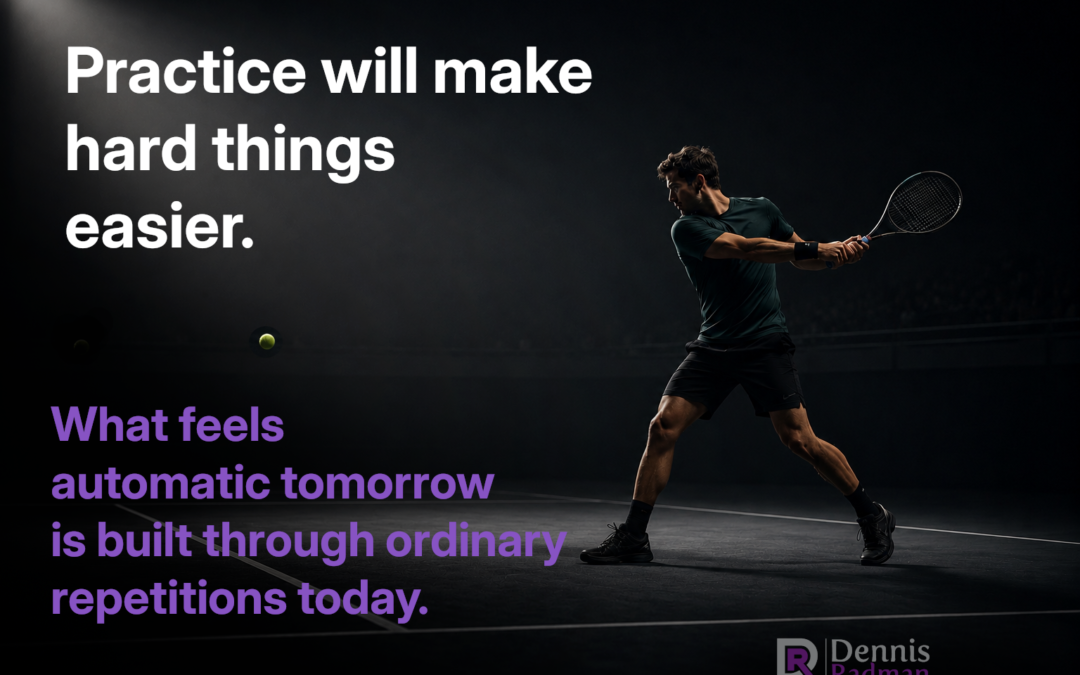
The repetitions that feel ordinary today become the abilities you stop noticing tomorrow.
For more than thirty years, soccer was part of my identity. Weekends revolved around matches. Summers revolved around tournaments. Like many people who have played a sport for decades, I assumed there would always be another season. Then I tore my ACL. Surgery followed, rehabilitation followed, and eventually I accepted that the kind of soccer I loved was over. Losing a sport that had been woven into my life for so long felt like losing a small part of myself.
Fortunately, I have good friends.
Not long after my surgery, they invited me to play golf. They thought it would get me out of the house, keep me active, and maybe fill a little of the void that soccer had left behind. I had never really played before, so I agreed. Standing on the first tee, however, it quickly became obvious that enthusiasm and ability are two very different things. I swung. I missed the ball. I swung again. I missed it again. By the time I had missed the ball ten times, I wasn’t thinking about golf anymore. I was thinking about how quickly I could disappear without anyone noticing.
Nobody laughed.
Nobody offered a swing lesson.
Nobody told me to keep my head down or slow my backswing.
One of my friends simply said, “You’ll play your next shot where Dave’s is. No worries, we’ve all been there.”
Then we walked down the fairway and kept playing.
I’ve thought about that moment many times since. My friends probably believed they were simply helping a beginner enjoy a round of golf. Looking back as a rehabilitation clinician, I see something much more interesting. They protected my participation. Instead of allowing one frustrating moment to become the end of the day, they quietly removed the obstacle that would almost certainly have made me give up. They lowered the difficulty just enough that I could stay involved, take another swing, and then another. They didn’t solve the problem for me. They created another opportunity to practise.
Two years later, I was still practising.
I had spent time at the driving range. I had played dozens of rounds with friends. None of those individual rounds felt particularly remarkable. I certainly never drove home thinking, “Today I became a golfer.” Most days felt ordinary. Some felt frustrating. A few felt encouraging. Yet somewhere along the way, something changed. The swing that had once required every ounce of my concentration slowly became less demanding. I stopped analysing every movement. I stopped feeling embarrassed. I started enjoying the game.
I wasn’t witnessing dramatic progress.
I was experiencing accumulated progress.
Practice makes hard things easier.
The repetitions that feel ordinary today become the abilities you stop noticing tomorrow.
People often ask, “How long does it take to form a habit?” It is an understandable question, but it assumes that automaticity follows a predictable schedule. Behavioural science paints a much more interesting picture.
One of the most influential studies in this area was conducted by Phillippa Lally and her colleagues. Their work is frequently reduced to a simple headline: it takes sixty-six days to form a habit. That is not what the study concluded. Sixty-six days happened to be the average for relatively simple health behaviours, but the participants ranged from approximately eighteen days to two hundred and fifty-four days before their behaviours approached automaticity. The average became famous. The variability is what clinicians should remember.
Measurement researchers often remind their students that before asking how much or how long, we should first ask what exactly are we measuring? Automaticity is not like flipping a light switch. It does not suddenly appear on Day 66. It develops gradually. A behaviour demands a little less attention, a little less mental effort, and a little more confidence with each successful repetition. The boundaries are fuzzy because learning itself is gradual.
That becomes even more important in rehabilitation. Lally’s participants were developing relatively simple daily behaviours. Rehabilitation is rarely that straightforward. Returning to work after a brain injury, rebuilding confidence after chronic pain, learning to manage overwhelming emotions, or returning to meaningful community participation all involve multiple systems working together. They require physical learning, cognitive learning, emotional learning, and often social learning. Expecting those changes to follow a single timeline misunderstands both rehabilitation and human behaviour.
The better question is not, “How many days will this take?”
The better question is, “What conditions make learning more likely?”
Complex behaviours usually require more repetitions than simple ones. Behaviours performed every day accumulate experience faster than behaviours performed once a week. Stable routines make learning easier than constantly changing environments. Pain, fatigue, anxiety, grief, executive dysfunction, and sensory overload all increase the effort required for each repetition. None of those factors prevent learning, but they do remind us that meaningful change rarely follows a neat schedule.
That is why meaningful participation occupies such a central place in rehabilitation.
Participation is not simply the destination.
Participation is often the mechanism that gets us there.
I have lived through that lesson more than once. Writing followed almost exactly the same trajectory as golf. For years, writing felt slow, awkward, and frustrating. I often avoided it because every page seemed to require enormous effort. Over time, however, small changes accumulated. Microsoft Word caught some of my mistakes. Grammarly caught others. A colleague encouraged me to co-author articles for a professional magazine. Graduate school demanded more writing. Clinical practice demanded even more through reports, assessments, and correspondence. None of those experiences transformed me individually. Together, they transformed how writing felt.
Today, I write because I enjoy it.
That sentence would have surprised a younger version of me.
The interesting part is that I cannot tell you exactly when that change happened. There was no breakthrough afternoon when writing suddenly became easy. There were simply hundreds of ordinary writing sessions, most of which felt completely unremarkable while I was living through them. Looking back, however, the pattern is obvious. The repetitions that once felt frustrating quietly became competence.
Perhaps that is the most hopeful lesson rehabilitation has to offer.
We are remarkably poor judges of our own progress because we compare today with yesterday. Learning does not work on yesterday’s timeline. It works on accumulated experience. Most meaningful changes are too gradual to notice while they are unfolding. We only appreciate them when we look back and realize that something which once demanded our full attention now happens almost effortlessly.
The first article in this series argued that every repetition is practice. This article adds a second idea. Practice is rarely exciting. Most of it feels routine. Some of it feels boring. Some of it feels frustrating enough to make us wonder whether it is accomplishing anything at all.
Then, one day, you find yourself doing something that once seemed impossibly difficult.
Not because of one extraordinary moment.
Because of hundreds of ordinary ones.
References
Krakauer, J. W., Hadjiosif, A. M., Xu, J., Wong, A. L., & Haith, A. M. (2019). Motor learning. Comprehensive Physiology, 9(2), 613-663.
Lally, P., van Jaarsveld, C. H. M., Potts, H. W. W., & Wardle, J. (2010). How are habits formed: Modelling habit formation in the real world. European Journal of Social Psychology, 40(6), 998-1009.
Schmidt, R. A., Lee, T. D., Winstein, C. J., Wulf, G., & Zelaznik, H. N. (2019). Motor Control and Learning: A Behavioral Emphasis (6th ed.). Human Kinetics.
Wood, W., & Rünger, D. (2016). Psychology of habit. Annual Review of Psychology, 67, 289-314.
Recent Comments