
Why You Cannot Always See What Has Changed After a Brain Injury
The Question Families Keep Asking
Families often ask me some version of the same question: “Does my son understand why he cannot do that anymore?”
It sounds like a question with a yes-or-no answer. It is not. A person may know that they sustained a brain injury, recognize some physical changes, and repeat that their memory or concentration is worse. Yet that same person may not notice an error while it is happening, understand afterward why a task went wrong, predict the same difficulty next time, or use a strategy without prompting.
Awareness is not a single fact that a person either knows or does not know. It is a collection of brain processes that allow us to build, monitor and update an understanding of ourselves. These processes help us answer questions such as: What can I do? What is difficult for me? How am I performing right now? What is likely to happen next? What support will I need?
After an acquired brain injury, the systems required to answer those questions may themselves be impaired. This creates one of the most confusing situations in rehabilitation: the person may be unaware of a difficulty because the brain processes needed to detect, remember and understand that difficulty are not working as they once did.
This article explains concepts and summarizes approaches described in brain injury research and rehabilitation. It does not determine what any individual client or family should do. The meaning of a behaviour, the suitability of an intervention, and decisions involving support or safety depend on individualized assessment and context.
Awareness Is a Brain Function
We tend to imagine awareness as a clear window through which we observe our own minds. In reality, most brain activity never enters conscious experience. The brain filters information, fills gaps, generates predictions and presents us with an interpretation of reality. We experience the result, not the enormous amount of processing that produced it.
Colour blindness offers a familiar example. A person with a colour-vision difference does not receive a notification that part of their visual experience is missing or altered. The world simply looks the way their nervous system presents it. They may learn through testing or comparison that they distinguish colours differently, but they cannot step outside their own visual system and directly experience the difference in the same way another person does (Gegenfurtner & Kiper, 2003).
Visual illusions reveal something related. Even after an illusion is explained, the brain often continues producing the same misleading percept. Intellectual knowledge has changed, but the underlying perceptual process has not. A person can understand that the lines are equal while continuing to see one as longer. Knowing what the brain is doing does not necessarily give us control over it (Eagleman, 2001).
These examples establish two important principles:
The brain can omit, alter or interpret information without making us aware of the process.
Understanding that a process is unreliable does not automatically make the process function normally.
These are normal examples of the brain’s opacity. They are not demonstrations of brain injury. They are useful because they show why none of us can simply look inward and obtain a complete, objective account of what our brain is doing.
Awareness Has Several Levels
Clinical models of awareness commonly distinguish between knowing about a difficulty, noticing it during performance and anticipating its effect on a future activity. More recent reviews describe awareness as multidimensional, dynamic and influenced by cognition, emotion, feedback and context (Sansonetti et al., 2022). Table 1 presents five levels that are useful for distinguishing what a person may understand from what they can notice, predict or act upon.
Table 1
Levels of Awareness After Acquired Brain Injury
| Level of awareness | The underlying question | Example after brain injury |
| Intellectual awareness | Do I know that I have a difficulty? | “My memory is worse since the injury.” |
| Online or emergent awareness | Do I notice the difficulty while it is happening? | “I have lost track of what I was doing.” |
| Retrospective awareness | Can I accurately understand what happened afterward? | “I missed the appointment because I relied on my memory and did not check my calendar.” |
| Anticipatory awareness | Can I predict when the difficulty will affect me? | “This task has several steps, so I will need to write them down.” |
| Strategy awareness | Can I select and use an appropriate support? | The person independently sets a reminder, checks the plan or asks for assistance. |
Note. The levels are presented as a conceptual scaffold. They can overlap, vary by task and context, and do not necessarily develop in a fixed sequence.
These levels can separate. A client may accurately say, “I have memory problems,” but fail to recognize that a forgotten conversation caused the current disagreement. Another person may notice an error after it occurs but still predict that the next similar task will go normally. A third may understand the problem and know which strategy would help, but lack the initiation required to use it.
The useful clinical question is therefore not simply, “Does this person have awareness?” It is:
Awareness of what, at which level, under what conditions, and demonstrated through what behaviour?
The Brain Maintains a Working Model of the Self
Over a lifetime, the brain builds expectations about what we can do. Repeated experiences become skills, habits and stable self-knowledge. A person does not approach every familiar activity as if it were completely new. The nervous system uses prior experience to predict what will happen, select an action, perform it and adjust when necessary.
Predict → plan → perform → monitor → compare → update → predict again
This loop depends on many systems working together. Attention must select relevant information. Working memory must hold the goal and current task state. Memory must retain previous outcomes. Executive functions must compare intention with performance, detect discrepancies, inhibit an ineffective response and modify the plan. Emotional systems influence which feedback is tolerated, avoided or emphasized.
Research does not support the idea of a single “awareness centre” in the brain. Error monitoring and self-evaluation appear to depend on interactions among distributed networks, including frontoparietal control systems and regions involved in detecting important internal and external events. After traumatic brain injury, impaired self-awareness has been associated with disrupted functional communication across these networks rather than simply the location of one visible lesion (Ham et al., 2014). People with traumatic brain injury may also detect fewer attentional and inhibitory errors during task performance (O’Keeffe et al., 2007). Figure 1 shows how these systems contribute to an ongoing cycle of prediction, performance and revision.
Figure 1 The Awareness and Updating Loop
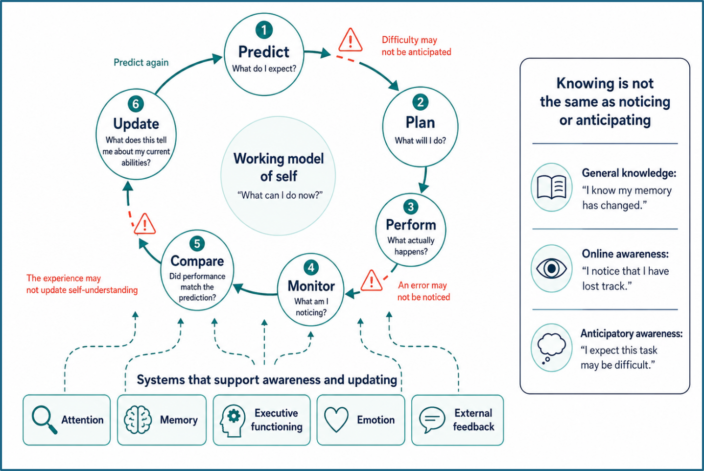
Note. This conceptual figure is intended to illustrate relationships among processes. It does not represent a single anatomical pathway or a fixed sequence of recovery.
When an Old Prediction Meets a Changed Nervous System
Consider a person who played tennis for 15 years. They have accumulated thousands of experiences judging the ball, moving into position, selecting a stroke, controlling force and recovering for the next shot. Much of this performance became automatic. The person does not merely remember playing tennis. Their nervous system predicts and organizes the activity using years of practice.
After a brain injury, some of the original skill may remain, but the systems supporting it may have changed. Balance, visual processing, reaction time, divided attention, motor control, endurance or emotional regulation may now be less reliable. The person begins the activity with a prediction built from years of mastery, but the current nervous system cannot consistently produce the expected result.
The tennis court provides immediate feedback. The ball hits the net, lands outside the court or goes somewhere other than intended. The player may also feel that the stroke required more effort or that their body was late getting into position. The environment quickly announces that the prediction and performance did not match.
At first, a small number of poor performances may reasonably be interpreted as rust, fatigue or an unusually bad day. Healthy people do not reconstruct their identities after every mistake. Stable self-models protect us from treating every temporary failure as evidence of permanent change.
The problem arises when the old model continues to dominate despite accumulating evidence. Years of successful performance have been consolidated into strong procedural expectations and a stable belief: “I know how to do this.” The post-injury evidence is comparatively new. It may also be inconsistent, emotionally difficult, poorly monitored or weakly remembered.
A related idea has been described in dementia research as the “petrified self,” in which older, well-consolidated self-knowledge remains influential because newer autobiographical information does not adequately update it (Mograbi et al., 2009). Traumatic brain injury is a different condition, but research has also identified disruption in the ability to connect past, present and future representations of the self after traumatic brain injury (Coste et al., 2015). The clinically important principle is that a person may evaluate current ability using an older version of themselves.
This is not necessarily a complete reset of the skill. It is a loss of calibration between the person’s established self-model and the capabilities of the current system. Familiarity, intention and remembered mastery can all remain stronger than the still-developing evidence about present performance.
Cognitive Failures Are Harder to See
Physical activities such as tennis make the problem relatively visible. Complex cognitive activities are much more difficult because much of the performance occurs internally and many errors produce no immediate feedback.
Imagine planning a golf outing for four people. The task sounds simple: choose a course, find a date, book a tee time and tell everyone. Beneath that simple description is a network of cognitive demands. The organizer must gather each person’s availability, retain several restrictions, compare possible dates, consider travel time and equipment, make decisions, revisit earlier options, communicate the plan and remember later follow-up.
Suppose one person says, “I can play every other Saturday, but only between 8:00 a.m. and 1:30 p.m.” The planner must attend to the statement, encode it, bind the restrictions together, retain them, retrieve them when looking at tee times and use them to reject unsuitable options.
If that information is never stored, the planner cannot later remember forgetting it. There is no mental warning that says, “An availability restriction is missing.” The information simply does not participate in the plan.
Information not encoded → information unavailable for planning → no mismatch detected → plan feels complete
The same problem can occur when the information was stored but is not retrieved at the necessary moment:
Information not retrieved → constraint absent from the working model → no conflict detected → unsuitable time selected
In both cases, the person may confidently report, “I planned the outing.” From their perspective, they did. They selected a course, identified a date and perhaps reserved a tee time. What they cannot directly experience is the cognitive operation that failed to occur. Table 2 contrasts the feedback available during this planning task with the feedback available during a physical skill such as tennis.
Table 2
Differences in Feedback Between a Physical Skill and a Cognitive Planning Task
| Playing tennis | Planning a golf outing |
| Performance is externally observable. | Most of the performance occurs internally. |
| Feedback is immediate. | Feedback may be delayed by hours or days. |
| Errors often produce obvious outcomes. | An omission may leave no visible trace. |
| The body and environment provide continuous information. | Failed encoding or retrieval may produce no conscious sensation. |
| The person can adjust during the attempt. | The planning process may end before an error becomes apparent. |
| Failure is difficult to miss. | An incomplete plan can feel complete. |
| Cause and outcome are close together. | Cause and outcome may occur in different contexts on different days. |
Note. The comparison is illustrative rather than diagnostic. Physical and cognitive tasks can each involve both immediate and delayed feedback.
The Same Missing Information Can Affect Performance and Awareness
To recognize that a planning step is missing, the person must possess some representation of what a complete plan should contain. The monitoring system must compare the emerging plan against that standard.
If the planner has forgotten one person’s availability, the same missing information can impair both planning and monitoring. The planning system cannot use the forgotten restriction. The monitoring system cannot identify the omission because the restriction is also absent from the standard against which the plan is being checked.
Missing information → incomplete plan → incomplete internal standard → no discrepancy detected
The impairment has removed both the information and part of the evidence that would reveal that the information is missing. The absence of information does not feel like missing information.
External feedback may arrive later when the other person says, “I told you I cannot play that late.” But the organizer must now connect a present correction with an earlier failure of attention, encoding, retrieval or checking. That requires memory, causal reasoning and self-monitoring, which may also be impaired.
The event may consequently be interpreted as someone changing their mind, communicating poorly or being difficult. Even when the correction is accepted, the lesson may be remembered only as “that date did not work,” rather than “I failed to retain and integrate an important constraint.” The experience does not necessarily update the relevant self-understanding: “I now have difficulty holding and coordinating several pieces of information while planning.”
When Other People Quietly Repair the Plan
Families and rehabilitation professionals frequently prevent cognitive errors from becoming visible. Someone remembers the forgotten restriction, checks the reservation, sends a reminder or changes the tee time. The outing then happens successfully.
From the client’s perspective:
I planned the outing → we played golf → my planning worked
From the family’s perspective:
The outing was initiated → several details were missing → other people repaired the plan → the outing occurred
The successful outcome can conceal the impaired process. The person sees that the outing happened. The family sees the additional monitoring, prompting and correction required to make it happen.
The final outcome alone therefore provides an incomplete picture of awareness or independence. A fuller account may include how the outcome was produced, what information the person managed independently, which errors they detected, what support was present and whether strategy use was self-initiated.
Why Repeated Failure May Still Not Produce Awareness
The brain is not simply counting thousands of pre-injury successes against a dozen post-injury failures. Years of experience have been compressed into strong habits, procedural models and self-knowledge. New experiences influence that model according to how clearly they are noticed, how reliably they are remembered and how accurately they are interpreted.
For a new experience to update awareness, the person must detect what happened, encode it, remember it, connect cause with consequence, integrate it with similar experiences and use the pattern to change the next prediction. Brain injury can interfere with every stage.
Experience → detection → encoding → retention → interpretation → integration → future prediction
There is therefore no universal number of failures after which awareness appears. One clear, emotionally meaningful and well-remembered experience may have substantial influence. Fifty vague, inconsistently remembered experiences may have very little influence. Recovery also changes over time, so the person is attempting to learn about a system that may itself still be changing. Figure 2 illustrates why a self-model built from years of mastery may lag behind evidence from a smaller number of post-injury experiences.
Figure 2 The Competition Between Old Mastery and New Evidence
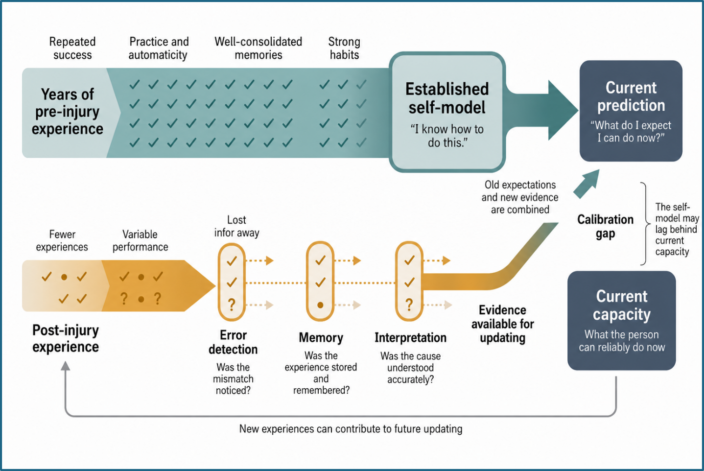
Note. The relative size of the two streams is conceptual rather than quantitative. The figure does not imply a universal threshold at which awareness changes.
Impaired Awareness Is Not Automatically Denial
A disagreement between a client and family member does not prove neurologically impaired awareness. Several explanations may coexist. The person may have impaired error monitoring, poor memory for previous examples, difficulty connecting cause and consequence, or a self-model that has not adequately updated. They may also be grieving, protecting a valued identity, avoiding painful conclusions, or genuinely performing differently in different environments.
Psychological denial and neurologically impaired self-awareness are not the same, although they can occur together. Prigatano and Sherer (2020) emphasize that distinguishing them matters because each may contribute differently to what the person reports, how they respond to feedback and how they participate in rehabilitation. Difficulties detecting an error raise different clinical questions from difficulties emotionally tolerating a recognized change. The distinction cannot be made from disagreement alone.
Awareness can also be domain-specific. A person may accurately recognize physical limitations while underestimating changes in memory, social judgement or emotional regulation. They may understand a problem in a quiet clinical setting but fail to recognize it under fatigue, distraction or time pressure.
Measuring Awareness: What Ruler Are We Using?
Nancy Mayo’s work in rehabilitation measurement provides an important discipline: recovery and disability cannot be understood through one score or one level of functioning. Impairment, everyday activity, participation and quality of life provide different information (Mayo et al., 2002). The same principle applies to awareness.
A questionnaire asking whether someone has memory problems measures something different from observing whether they recognize a forgotten instruction during a real task. A family member sees behaviour across months but may not observe every context. A clinician may conduct structured testing but see only a small and unusually supported sample of the person’s life. A cognitive test may identify impaired memory or executive functioning without establishing whether the person understands its everyday consequences.
Fleming et al. (1996) highlighted the limitations of relying on a single discrepancy score and described the value of multiple methods. Research and clinical frameworks may draw from the client’s account, family observations, structured interviews, performance on meaningful tasks, prediction-versus-performance comparisons, online error detection, spontaneous strategy use and behaviour across time and settings. Each source measures a different part of the construct.
Self-report + family observation + clinical assessment + real-world performance + repeated observation
Differences among these sources may themselves be informative. They can reveal how awareness varies across settings, demands, observers and levels of support, without assuming that any one perspective is always correct.
How Rehabilitation Has Approached Awareness
Research indicates that awareness can change over time and may respond to intervention. Barbara Wilson’s work has consistently advanced a practical, holistic view of neuropsychological rehabilitation in which cognitive processes are considered alongside everyday functioning, personal goals, emotion and psychosocial life (Wilson, 2008).
One approach studied in rehabilitation attempts to make hidden cognitive processes more observable. A person may be asked to predict how long an activity will take, what might be difficult, how many prompts may be needed or which strategy may help. Their predictions can then be compared with observed performance. This comparison provides information about the accuracy of prediction, error detection and retrospective understanding.
Predict → perform → observe → compare → update → try again
In research and clinical practice, prediction-performance comparisons have been examined through structured exercises and everyday activities. Some approaches have incorporated video feedback, written plans, calendars, checklists or visible task criteria. These methods differ, but each externalizes information that would otherwise depend on memory and internal monitoring. Whether any method is suitable depends on the person, the purpose of the intervention, consent, emotional response, clinical judgement and the circumstances in which it would be used.
Controlled research has found that task-based awareness interventions can improve awareness and everyday task performance (Goverover et al., 2007). A recent systematic review and meta-analysis also found positive overall effects for interventions targeting self-awareness after acquired brain injury, with metacognitive approaches showing particular promise (Villalobos et al., 2025). Evidence-based cognitive rehabilitation recommendations support metacognitive strategy instruction for executive dysfunction and comprehensive, holistic rehabilitation for reducing functional disability (Cicerone et al., 2019).
Goal Management Training is one example of a metacognitive intervention. It incorporates deliberate pauses, restating the goal, dividing activities into steps, monitoring progress and adjusting the plan. Early controlled work found improvements on tasks designed to resemble everyday executive problems (Levine et al., 2000). It illustrates how rehabilitation may study or support monitoring through procedures that are more explicit than the automatic processes used before injury.
External supports may also be used when a person’s internal monitoring or memory is unreliable. In those circumstances, part of the information needed for performance exists in the environment rather than solely in the person’s memory. The appropriate balance among independence, assistance, autonomy and risk is individual and cannot be determined from awareness alone.
Why Client and Family Perspectives Can Differ
Clients and family members often possess different evidence. The client has direct access to their intentions, effort and subjective experience. Family members may observe repeated outcomes, prompting, corrections and changes across settings. Neither perspective captures the entire process.
A global statement such as “You cannot plan anything anymore” and a description of a particular planning event provide different kinds of information. The first makes a broad judgement about competence. The second can identify the original prediction, the observed outcome and any support that affected that outcome. This distinction helps explain why conversations about awareness may become confused even when everyone is describing something real.
Family assistance can also make performance difficult to interpret. A successful activity may reflect the client’s independent planning, effective collaboration, extensive prompting, quiet correction by others or some combination of these. Without examining the process, the client and family may understandably draw different conclusions from the same final outcome.
Questions involving safety, supervision, autonomy, consent or decision-making capacity extend beyond a general discussion of awareness. They are individualized clinical and legal questions that cannot be resolved by a general educational article.
Awareness Can Carry an Emotional Cost
Improved awareness is not an uncomplicated victory. As the person develops a clearer understanding of change, they may also encounter grief, fear, anxiety, shame or uncertainty about identity and the future. In a small occupation-based rehabilitation study, gains in awareness were accompanied by increased anxiety in all four participants (Fleming et al., 2006). The study was small, but the clinical lesson is important.
The emotional consequences of changing awareness are therefore relevant to how rehabilitation is understood and evaluated. A change in self-understanding may occur alongside greater distress, greater engagement, improved strategy use or a mixture of outcomes. Awareness is not automatically beneficial in every respect, and a higher score does not describe the whole person’s adjustment or quality of life.
A Better Answer to the Family’s Question
When a parent asks, “Does my son understand why he cannot do that anymore?” the most accurate response may be that he understands some parts but not others. He may know the diagnosis without recognizing a particular error. He may see the error afterward without understanding its cause. He may understand the cause without predicting the same problem next time. He may know which strategy would help but fail to initiate it.
Awareness after brain injury is not simply honesty, intelligence, motivation or acceptance. It is the capacity to build, monitor and update an accurate working model of oneself, and to use that model to guide behaviour.
When memory, executive functioning and error monitoring are impaired, the person can become opaque to what was not noticed, not stored, not retrieved or not completed. One focus within rehabilitation research is whether parts of that hidden process can be made more observable and memorable, allowing predictions about current functioning to become more accurate over time.
The clinical importance of awareness lies in its relationship with decisions, strategy use, independence, participation and valued relationships. How those aims are balanced remains specific to the person and their circumstances.
References
Cicerone, K. D., Goldin, Y., Ganci, K., Rosenbaum, A., Wethe, J. V., Langenbahn, D. M., Malec, J. F., Bergquist, T. F., Kingsley, K., Nagele, D., Trexler, L., Fraas, M., Bogdanova, Y., & Harley, J. P. (2019). Evidence-based cognitive rehabilitation: Systematic review of the literature from 2009 through 2014. Archives of Physical Medicine and Rehabilitation, 100(8), 1515–1533. https://doi.org/10.1016/j.apmr.2019.02.011
Coste, C., Navarro, B., Vallat-Azouvi, C., Brami, M., Azouvi, P., & Piolino, P. (2015). Disruption of temporally extended self-memory system following traumatic brain injury. Neuropsychologia, 71, 133–145. https://doi.org/10.1016/j.neuropsychologia.2015.03.014
Eagleman, D. M. (2001). Visual illusions and neurobiology. Nature Reviews Neuroscience, 2(12), 920–926. https://doi.org/10.1038/35104092
Fleming, J. M., Lucas, S. E., & Lightbody, S. (2006). Using occupation to facilitate self-awareness in people who have acquired brain injury: A pilot study. Canadian Journal of Occupational Therapy, 73(1), 44–55. https://doi.org/10.2182/cjot.05.0005
Fleming, J. M., Strong, J., & Ashton, R. (1996). Self-awareness of deficits in adults with traumatic brain injury: How best to measure? Brain Injury, 10(1), 1–15. https://doi.org/10.1080/026990596124674
Gegenfurtner, K. R., & Kiper, D. C. (2003). Color vision. Annual Review of Neuroscience, 26, 181–206. https://doi.org/10.1146/annurev.neuro.26.041002.131116
Goverover, Y., Johnston, M. V., Toglia, J., & DeLuca, J. (2007). Treatment to improve self-awareness in persons with acquired brain injury. Brain Injury, 21(9), 913–923. https://doi.org/10.1080/02699050701553205
Ham, T. E., Bonnelle, V., Hellyer, P., Jilka, S., Robertson, I. H., Leech, R., & Sharp, D. J. (2014). The neural basis of impaired self-awareness after traumatic brain injury. Brain, 137(2), 586–597. https://doi.org/10.1093/brain/awt350
Levine, B., Robertson, I. H., Clare, L., Carter, G., Hong, J., Wilson, B. A., Duncan, J., & Stuss, D. T. (2000). Rehabilitation of executive functioning: An experimental-clinical validation of goal management training. Journal of the International Neuropsychological Society, 6(3), 299–312. https://doi.org/10.1017/S1355617700633052
Mayo, N. E., Wood-Dauphinee, S., Côté, R., Durcan, L., & Carlton, J. (2002). Activity, participation, and quality of life 6 months poststroke. Archives of Physical Medicine and Rehabilitation, 83(8), 1035–1042. https://doi.org/10.1053/apmr.2002.33984
Mograbi, D. C., Brown, R. G., & Morris, R. G. (2009). Anosognosia in Alzheimer’s disease: The petrified self. Consciousness and Cognition, 18(4), 989–1003. https://doi.org/10.1016/j.concog.2009.07.005
O’Keeffe, F. M., Dockree, P. M., Moloney, P., Carton, S., & Robertson, I. H. (2007). Characterising error-awareness of attentional lapses and inhibitory control failures in patients with traumatic brain injury. Experimental Brain Research, 180(1), 59–67. https://doi.org/10.1007/s00221-006-0832-9
Prigatano, G. P., & Sherer, M. (2020). Impaired self-awareness and denial during the postacute phases after moderate to severe traumatic brain injury. Frontiers in Psychology, 11, Article 1569. https://doi.org/10.3389/fpsyg.2020.01569
Sansonetti, D., Fleming, J., Patterson, F., & Lannin, N. A. (2022). Conceptualization of self-awareness in adults with acquired brain injury: A qualitative systematic review. Neuropsychological Rehabilitation, 32(8), 1726–1773. https://doi.org/10.1080/09602011.2021.1924794
Villalobos, D., Bivona, U., & Botella, J. (2025). Self-awareness interventions after acquired brain injury: A systematic review and meta-analysis. Rehabilitation Psychology, 70(4), 496–507. https://doi.org/10.1037/rep0000598
Wilson, B. A. (2008). Neuropsychological rehabilitation. Annual Review of Clinical Psychology, 4, 141–162. https://doi.org/10.1146/annurev.clinpsy.4.022007.141212
Recent Comments