
One of the privileges of working in rehabilitation is that you spend your career watching people learn. Sometimes they learn skills that help them reclaim parts of their lives after an illness or injury. Other times, often without realizing it, they become remarkably good at behaviours that quietly move them further away from the life they want.
The interesting part is that the same learning process is happening all the time. It is not reserved for the therapy clinic, the gym, or the classroom. Every day, our nervous system is paying attention to what we repeatedly do. Some of those repetitions strengthen behaviours that serve us well. Others strengthen behaviours we eventually wish had never become so automatic.
Every now and then, that lesson appears in such an ordinary moment that it catches you off guard.
That happened to me one Saturday morning.
I wasn’t working that day. I climbed into my car to pick up a few groceries. The store is only a couple of minutes from my house, and I had made the trip countless times before. I started the car, turned on the radio, and headed out as I always did.
A few minutes later, something felt wrong.
I wasn’t anywhere near the grocery store.
Instead, I was almost pulling into a client’s driveway.
For about eighteen months, I had worked with this client four times each week. He lived about seven minutes from my home, and I had driven that route hundreds of times. The grocery store and his house shared the same first stretch of road, so the beginning of each trip looked almost identical. Somewhere along the way, my attention drifted, and without any conscious decision, I continued along the route I had rehearsed hundreds of times before.
As a rehabilitation clinician, there was nothing surprising about what had happened. I had spent years learning about behaviour, automaticity, and motor learning. What made me smile was that I had just become another example of the very principle I had explained to clients so many times before. For a brief moment, my conscious plan had stepped aside, and a well-practised behavioural pattern quietly took over.
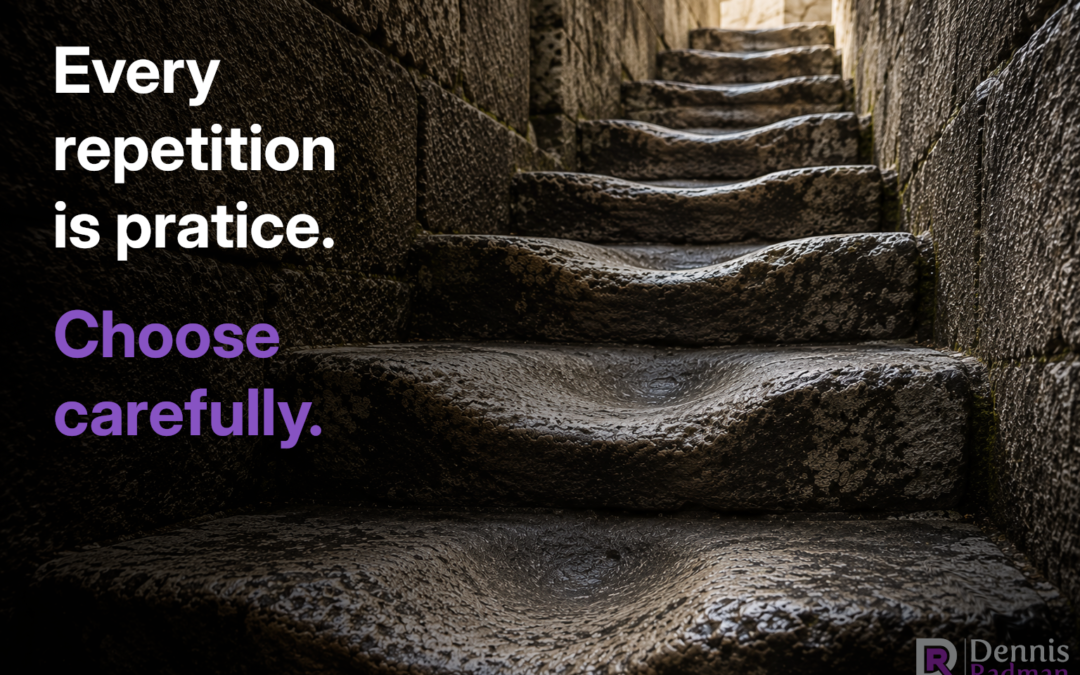
Every repetition is practice.
Every time you repeat a behaviour, you are teaching your nervous system that this behaviour is worth repeating.
When most people hear the word practice, they think about deliberate improvement. We practise a musical instrument before a performance. We practise a speech before standing in front of an audience. We practise a golf swing because we hope it becomes smoother and more consistent. Practice is something we choose.
Our nervous system has a much broader definition.
It learns from repetition, whether or not we intended to practise.
That simple idea helps explain why human behaviour can become so remarkably efficient. Repeated actions gradually require less conscious effort. They become smoother, faster, and increasingly automatic. Imagine having to consciously think through every movement involved in tying your shoes, making coffee, or driving to work. Everyday life would quickly become exhausting. Automaticity is one of the nervous system’s greatest achievements because it frees our attention for new and unfamiliar challenges.
The difficulty is that the nervous system does not reserve this efficiency for behaviours we consider helpful. It also becomes highly efficient at behaviours that work against our long-term goals. It simply learns from repetition. If a behaviour occurs often enough, especially in familiar situations, it gradually becomes easier to perform the next time those circumstances arise.
That principle appears almost everywhere in rehabilitation.
A person recovering from a brain injury may begin avoiding noisy restaurants because they trigger headaches and fatigue. Initially, that decision may be entirely appropriate. Reducing sensory overload is often an important part of recovery. Over time, however, if every challenging environment is avoided, the person is not only managing symptoms. They are also rehearsing avoidance. Each repetition makes avoidance a little more familiar, a little more efficient, and a little more likely to occur again.
The same process appears in chronic pain. Someone experiences pain while lifting, so they stop lifting altogether. The short-term relief is real, but every repetition teaches the nervous system that movement is something to avoid. We see similar patterns in anxiety, procrastination, social withdrawal, reassurance seeking, conflict, and countless everyday behaviours. Most people are not consciously choosing these patterns. They are simply repeating them, often because the repetition provides immediate relief while quietly shaping future behaviour.
This is why rehabilitation focuses so heavily on behaviour rather than intention alone. Motivation matters. Insight matters. Goals matter. They help determine where we want to go. Behaviour, however, is what teaches the nervous system how to get there. Every completed walk, every conversation that was not avoided, every successful return to a meaningful activity, and every morning routine that is followed becomes another repetition. Individually, those repetitions seem almost insignificant. Collectively, they become learning.
The encouraging part is that the same principle works in our favour.
If repetition can strengthen behaviours that keep us stuck, it can also strengthen behaviours that move us forward. Confidence is often built this way. Independence is often built this way. Recovery is often built this way. We tend to imagine change arriving through dramatic breakthroughs, yet most lasting change looks surprisingly ordinary. It is another walk around the block. Another difficult conversation. Another attempt to use an affected arm. Another visit to the grocery store. Another day of following through, even when motivation is less than perfect.
Those moments rarely feel important while they are happening.
Together, they become a different life.
The Saturday morning I almost drove to work instead of the grocery store was a harmless mistake, but it became a memorable reminder of something I had been teaching for years. Our behaviours are never isolated events. They are repetitions, and repetitions teach. Whether we realize it or not, every action is quietly shaping the next one.
The next time you notice yourself repeating a familiar behaviour, pause for a moment before continuing.
Ask yourself one simple question.
What am I teaching my nervous system?
References
Lally, P., van Jaarsveld, C. H. M., Potts, H. W. W., & Wardle, J. (2010). How are habits formed: Modelling habit formation in the real world. European Journal of Social Psychology, 40(6), 998-1009.
Krakauer, J. W., Hadjiosif, A. M., Xu, J., Wong, A. L., & Haith, A. M. (2019). Motor learning. Comprehensive Physiology, 9(2), 613-663.
Wood, W., & Rünger, D. (2016). Psychology of habit. Annual Review of Psychology, 67, 289-314.
Recent Comments